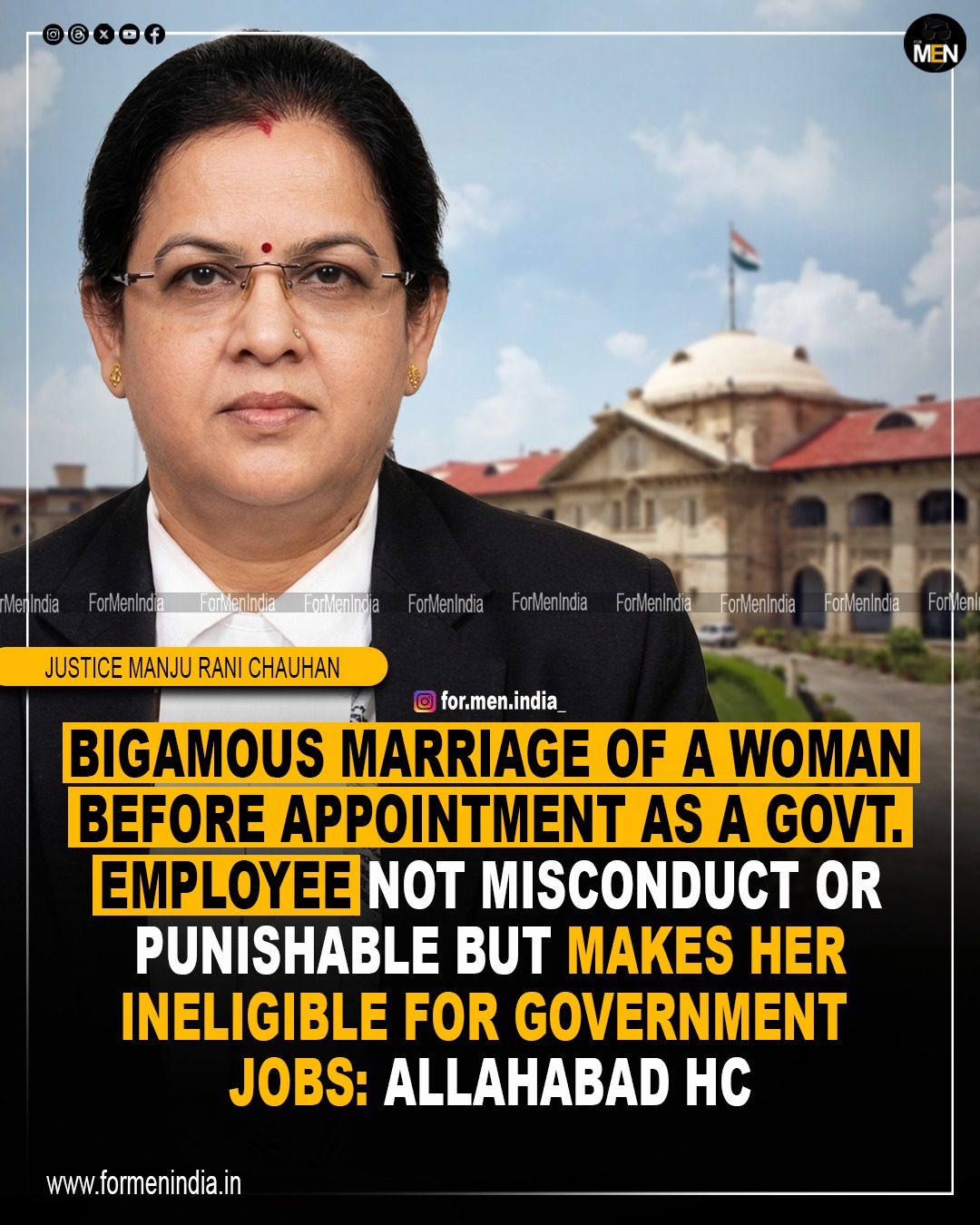
The Allahabad High Court has held that a woman, who entered into a bigamous marriage before being appointed as a government school teacher, cannot be punished for misconduct on this ground under U.P. Government Servant Conduct Rules and U.P. Government Servants (Discipline and Appeal) Rules.
Justice Manju Rani Chauhan noted that in the present case the petitioner, whose services were terminated, had married a man in 2009 during the “subsistence of his first marriage with another woman”; however the petitioner was appointed as an Assistant Teacher only in 2015.
The court held that applicability of the Conduct Rules, 1956 is confined to those who have entered government service, and the Rules cannot be invoked against a person at a stage prior to appointment. It further said that any interpretation extending their operation to candidates or persons not yet in service would be contrary to the plain language of the Rules and the settled principles of statutory construction.
In 2015, Petitioner was appointed as an Assistant Teacher in a primary school. Based on a complaint that the petitioner had married someone who was already married, her services were terminated. Petitioner challenged her termination order before the High Court on grounds that no inquiry was conducted before terminating her and that she was not aware of the first marriage of her husband.
The Court noted that Rule 29(2) of the U.P. Government Servant’s Conduct Rules, 1956 provides that no female employee shall marry a man who has a living wife without prior permission of the Government.
It noted that Section 19 of the U.P. Basic Education Act, 1972 empowered the State Government to make rules regarding he recruitment, and the conditions of service of the persons appointed, to the posts of teachers and other employees of basic schools recognized by the Board.
Further, Rule 12 of the U.P. Basic Education (Teachers) Service Rules, 1981 provides that a male candidate with more than one living wife and a female candidate who marries a man who already has a living wife shall not be eligible for appointment in service provided the Board finds special grounds to exempt such person.
The Court observed that the aforesaid Rules were inapplicable on a person till they joined services and an employer-employee relationship was established. It noted that the petitioner had married in the year 2009, but joined services only in 2015.
The Court quashed the order terminating the petitioner’s services and directed the respondent Authorities to pass fresh reasoned order after giving due notice to the petitioner.
Despite ruling out misconduct, the Court drew a crucial distinction. It held that such an act may still strike at the root of eligibility for appointment.
The Bench observed that entering into a bigamous marriage, particularly where the legal validity of the marriage itself is questionable, could affect whether a candidate satisfies the basic legal and moral requirements for public employment. Thus, while disciplinary punishment may not be justified, the employer can still examine whether the appointment itself was validly granted.
The High Court ruled that:
- A bigamous marriage prior to appointment cannot be punished as misconduct under the U.P. Government Servant Conduct Rules.
- However, such conduct may invalidate or undermine eligibility for government employment.
Accordingly, the Court clarified that the case must be viewed from the standpoint of eligibility rather than disciplinary liability.
Case Title: Reena v. State