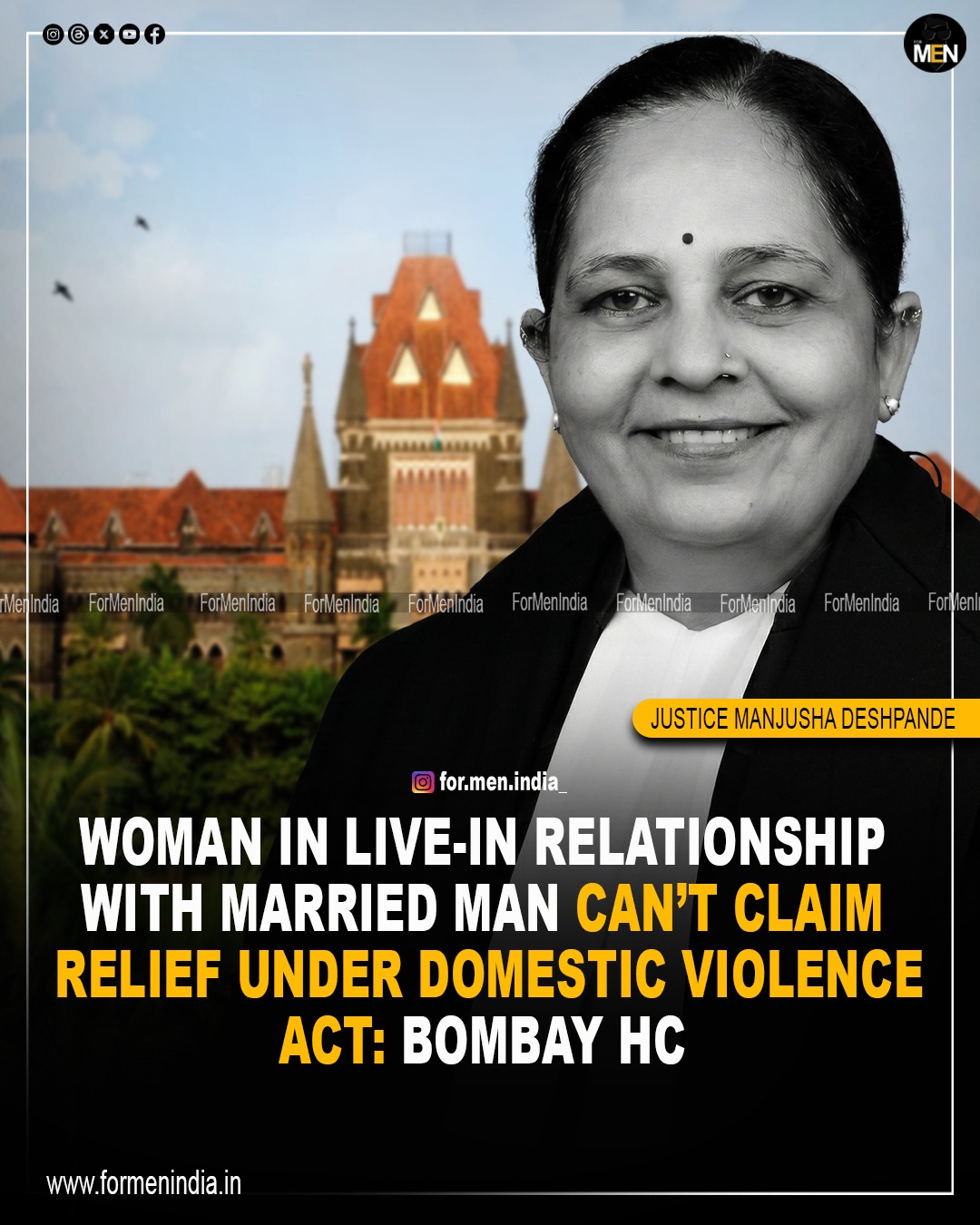
The Bombay High Court has determined that a woman involved in a relationship with a married man, while fully aware of his marital status, cannot seek relief under the Protection of Women from Domestic Violence Act, 2005 (PWDVA).
Justice Manjusha Deshpande dismissed the Writ Petition filed by the petitioner, affirming the Sessions Court’s decision, which had overturned the monetary reliefs and compensation previously granted to her by the Judicial Magistrate First Class (JMFC) in Pune.
The petitioner, an engineering student, claimed she was introduced to Respondent No. 1, a professor at her college, during her studies. She alleged that Respondent No. 1 initiated a relationship with her in 2001, claiming his wife (Respondent No. 2) was mentally ill.
According to her, Respondent No. 1 promised to marry her after obtaining a divorce. She claimed that on June 18, 2005, they secretly wed at a Ganapati Temple in Mahad against her parents’ wishes. Following this, she asserted that they cohabited as husband and wife in Mumbai and Pune, with Respondent No. 1 acting as her husband during her IVF treatment, which led to the birth of a son.
The petitioner filed a complaint under the PWDVA in 2011. On March 31, 2015, the JMFC, Pune, granted her application, ordering Respondent No. 1 to pay Rs. 28,000 monthly in maintenance, Rs. 5 lakh in compensation, and Rs. 10,000 for litigation costs.
However, this order was later challenged in the Sessions Court in Pune, which issued a common judgment on July 26, 2016, quashing the relief granted to the petitioner. Displeased with this ruling, the petitioner appealed to the High Court under Article 227 of the Constitution.
Advocate Narayan G. Rokade, representing the petitioner, argued that she entered the relationship based on the respondent’s deceit. He emphasized that they had participated in a marriage ceremony and cohabited for a significant time in both government quarters and rented accommodation. Respondent No. 1 managed her finances, holding power of attorney over her bank account. He signed consent forms for IVF treatment as her “husband,” which resulted in the birth of their child.
Advocate Sujay H. Gangal, representing the respondents, contended that the relationship could only be considered an extramarital affair. He claimed that the petitioner, being well-educated, entered into the relationship with full knowledge of Respondent No. 1’s marital status. He cited the Supreme Court’s ruling in Indra Sarma v. V.K.V. Sarma, arguing that a live-in relationship with a married person does not fall under Section 2(f) of the PWDVA. The allegations of coercive sexual relations and the legitimacy of the supposed marriage ceremony were disputed.
The Court stated,
“In the present case, Respondent No. 1, who is already married does not qualify condition No. (c), which requires that the parties must be otherwise qualified to enter into a legal marriage, including being unmarried.”
Relying on the Supreme Court’s judgment in Indra Sarma v. V.K.V. Sarma (2013), the High Court remarked that when a woman enters a relationship with knowledge of the man’s marriage, the relationship is characterized as that of a “concubine or mistress,” which does not qualify for protection under the PWDVA.
The Court reasoned that granting maintenance in such circumstances would be “against the interest of the legally wedded wife and children.”
The High Court concluded that the petitioner failed to demonstrate that her relationship with Respondent No. 1 was a “relationship in the nature of marriage” as required by the Act. Consequently, she was not entitled to relief under the PWDVA.