The prosecution’s case was that the complainant was subjected to domestic cruelty and harassment for a demand of dowry (₹8.5 lakh and a car as additional dowry), by her in-laws (sister-in-law and parents-in-law) and husband, after the dowry demand could not be acceded to owing to her parents’ financial incapacity and constraints.
She further alleged of her husband and in-laws for causing a miscarriage, and alleged that the father-in-law was engaged in a sexually inappropriate behaviour with her, leading her to file a FIR under Sections 498A, 323 and 313 of the Indian Penal Code, 1860 (hereinafter referred to as “IPC”), as well as Sections 3 and 4 of the Dowry Prohibition Act, 1961 (hereinafter referred to as “DP Act”).
The charge sheet came to be filed under Sections 323, 354, and 498A IPC, along with Sections 3 and 4 of the Dowry Prohibition Act, dropping the allegation of miscarriage as there was no medical proof substantiating the allegations.
Aggrieved by the High Court’s decision to dismiss their plea for quashing the criminal case, the in-laws appealed to the Supreme Court.
Setting aside the impugned order, the judgment authored by Justice Nagarathna observed that the prosecution’s case was entirely based on some bald allegations made by the complainant, the Court also found that the complainant was not vigilant about her rights, as the complaint was registered by the complainant only on 15.11.2023 i.e. after a delay of more than six years and seven months from the alleged dowry demand.
“A mere statement stating that the accused/appellants herein frequently demanded dowry and harassed the complainant for the same is not sufficient to initiate criminal proceedings against them when the same are not corroborated or bolstered by other materials placed on record.”, observed the bench.
The Court reiterated the principle laid down in Dara Lakshmi Narayana vs. State of Telangana, that a “mere reference to the names of family members in a criminal case arising out of a matrimonial dispute, without specific allegations indicating their active involvement should be nipped in the bud.”
Further, the complainant’s explanation that she feared her father-in-law, a reputed advocate, was rejected due to a lack of specific instances of threat or restraint over a prolonged period.
“merely making such statements claiming that there was sexual misconduct when the same are not substantiated or supported by any material detail in the Final Report filed by the Investigating Officer cannot be allowed to stand in the court of law.”, the court observed.
Also, the Court found that the Complainant was not interested in pursuing the case, as she remained absent from hearings despite being issued notice of the same.
“At this juncture, it would not be out of place to mention that the complainant herself has failed to enter appearance in the present proceedings despite service of notice upon her. The said non-appearance, despite the service of notice being complete upon her, inevitably draws our attention towards an adverse inference that the complainant herself is indifferent and uninterested in contesting the said appeals.”, the court observed.
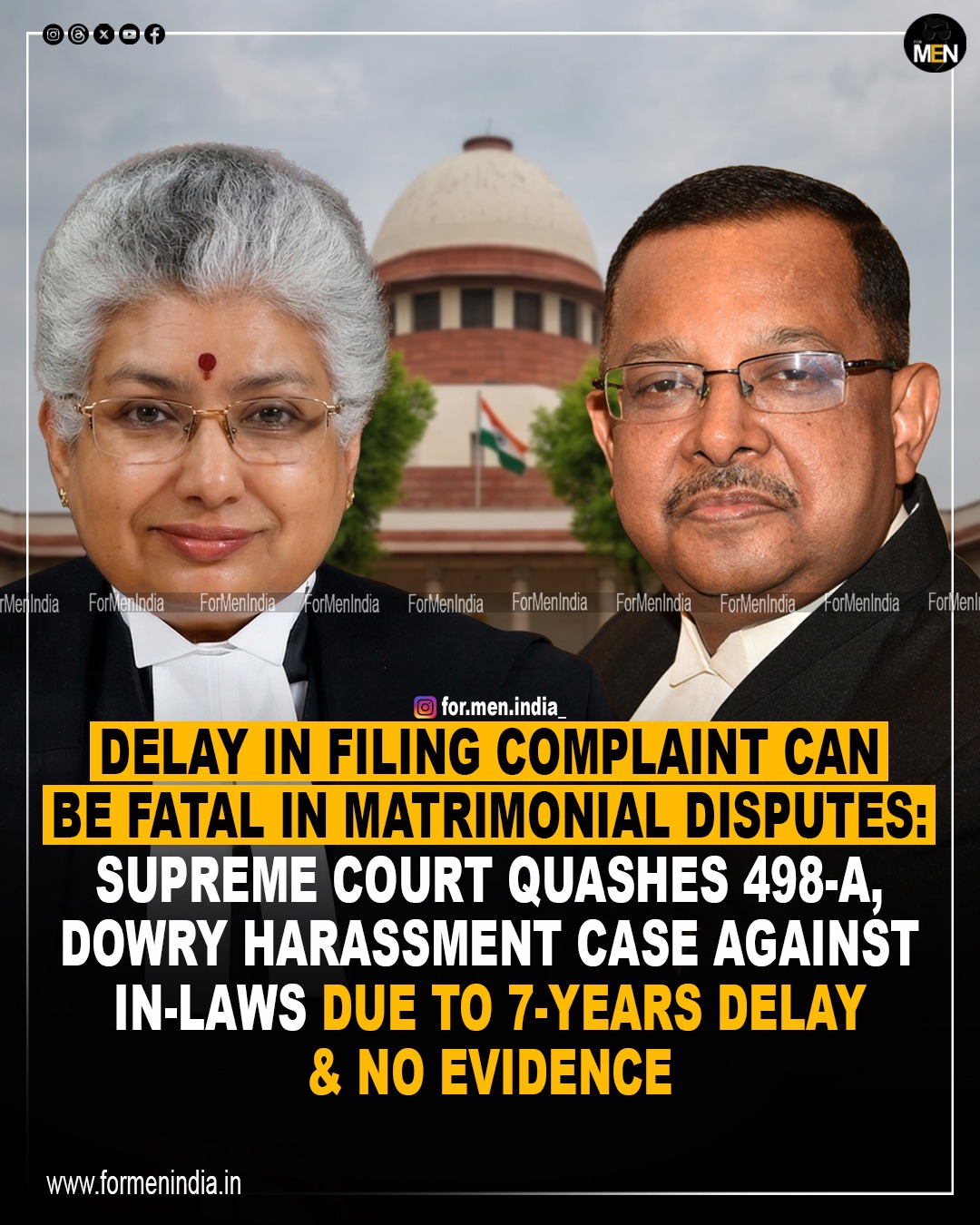
Emphasising that unexplained delay in initiating criminal proceedings can be fatal in matrimonial disputes, the Supreme Court quashed a dowry harassment case against a woman’s parents-in-law and sister-in-law, holding that a delay of nearly seven years without sufficient explanation cast serious doubt on the prosecution’s case.
In light of the aforesaid, the appeal was allowed, and pending cases against the in-laws were quashed.
Cause Title: CHARUL SHUKLA VERSUS STATE OF U.P. & OTHERS (with connected appeal)