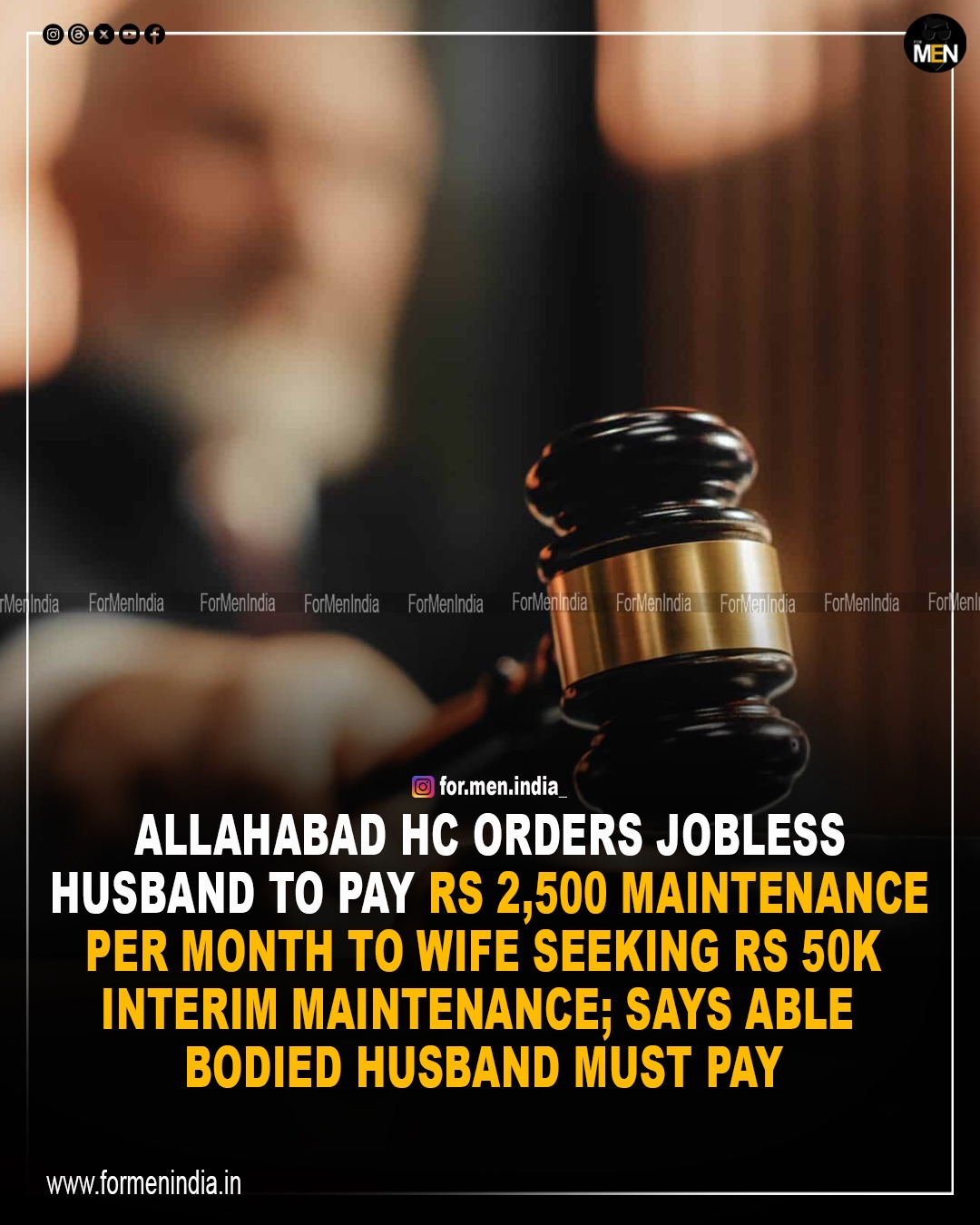
Reiterating that an able-bodied husband is duty-bound to support his wife and must earn “even by physical labour” to meet that obligation, the Allahabad High Court recently upheld a Family Court order directing a man to pay Rs. 2,500 per month as interim maintenance to his wife.
A single bench comprising Justice Saurav Lavania gave this ruling a few days back while dismissing a criminal revision petition filed by the husband against the order of the Family Court directing him to pay Rs 2500 per month as interim maintenance amount to his wife.
Court dismissed the revision petition filed by the man and directed that a copy of the order be sent to the court concerned.
The High Court relied on Supreme Court judgments in Anju Garg v. Deepak Kumar Garg, Chaturbhuj v. Sita Bai and Rajnesh v. Neha, wherein it has been held that Section 125 of the CrPC is a social-justice provision meant to prevent destitution and that a physically capable man cannot avoid his obligation by pleading unemployment. It also noted the Family Court’s finding that even a daily wage labourer would earn at least Rs. 12,500 a month at prevailing rates.
The Additional Principal Judge, Family Court, Lucknow, on 20 August 2025, allowed the wife’s maintenance plea filed in October 2021. The Family Court fixed interim support at Rs. 2,500 per month. The wife had sought Rs. 50,000 a month, claiming her husband earned around Rs. 1 lakh through a fruit business and additional income from property and bank deposits.
In her application, the wife said her November 2013 marriage was followed by dowry harassment, physical abuse and repeated demands for money. She alleged that she was beaten and left alone in a rented room after an incident in February 2021, forcing her to return to her parental home. She said she had no independent income to meet basic expenses.
The husband however denied the allegations, stating that the marriage was performed without dowry and that his wife frequently quarreled and refused to fulfil her marital responsibilities. He claimed he was unemployed, had earlier worked as a driver and that the fruit business mentioned by his wife had shut down. He also said his wife earned through stitching and embroidery work and was able to maintain herself.
The Family Court held that neither party had produced documentary proof of income. It observed that the husband’s legal duty to maintain his wife remained irrespective of fluctuations in income and assessed his minimum earning capacity on the basis of labour wages. It made the interim maintenance payable from the date of the application and directed that arrears be cleared within five months.
Before the High Court, the husband challenged the order and sought a referral to mediation, offering to deposit Rs. 25,000 before the Mediation Centre. Court rejected the proposal, noting that arrears from October 2021 would be close to Rs. 1.2 lakh and that he had shown no illegality in the Family Court’s decision.
Relying on the Supreme Court’s interpretation of maintenance laws, the High Court said the principles laid down in Anju Garg, Sita Bai and Rajnesh clearly place the onus on an able-bodied husband to ensure that his wife does not fall into destitution. It held that the Family Court had given adequate reasons and that the amount awarded was modest.
The revision was accordingly dismissed.
The wife initially sought ₹50,000 per month as interim maintenance, stating she had no income.
Husband’s Defense: The husband argued unemployment to avoid paying, but the court ruled he couldn’t escape his duty.
Court’s Reasoning: The High Court noted that an able-bodied man must work (even physically) to fulfill his responsibility to maintain his wife, as per Section 125 CrPC.
Case Title: Vikas Sharma vs. State Of U.P. Thru. Secy. Home Deptt. Lko. And Another