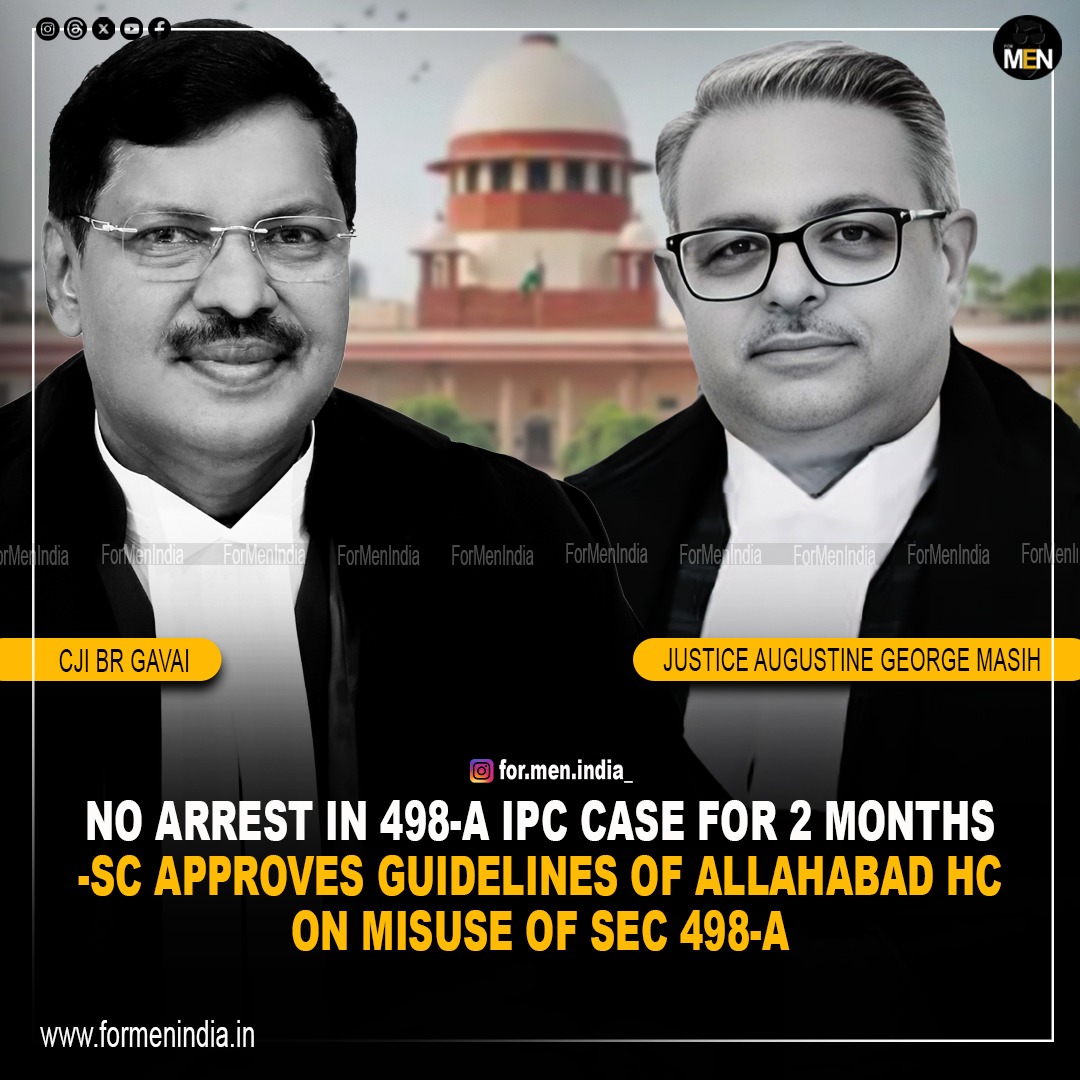
On July 22, the Supreme Court of India supported and adopted the guidelines issued by the Allahabad High Court that were meant to prevent the misuse of Section 498A of the Indian Penal Code (IPC), which deals with cruelty and dowry harassment against women.
These guidelines were issued two years ago by the Allahabad High Court on June 13, 2022, in Criminal Revision No. 1126 of 2022, and the Supreme Court has now made them applicable across the country.
A bench comprising Chief Justice of India (CJI) D Y Chandrachud and Justice A G Masih passed this decision while resolving a matrimonial dispute between 2022-batch Indian Police Service (IPS) officer Shivangi Bansal (also known as Shivangi Goel) and her estranged husband.
In this particular case, the Court noted that the woman IPS officer had filed multiple criminal cases against her husband and his family, which caused them immense suffering.
The bench observed, Because of the suffering caused by the multiple cases, the Court directed the IPS officer Shivangi Bansal to publish a formal apology in a leading English and Hindi newspaper, acknowledging the emotional and physical trauma experienced by her husband and his relatives due to the legal proceedings initiated by her.
The Supreme Court observed that this cooling-off period would allow the families involved in marital disputes some breathing space to explore reconciliation or settlement without the fear of immediate police action.
The case involved a long-standing dispute between Shivangi Bansal (also known as Shivangi Goel) and her husband Sahib Bansal. The couple had married in 2015 and had a daughter in 2016, but separated in 2018 due to growing marital issues.
Since their separation, over 20 different litigations—including domestic violence complaints, criminal cases under Section 498A IPC, maintenance claims, and transfer petitions—had been filed across courts in Delhi and Uttar Pradesh.
The key question before the court was whether arrests under Section 498A should be delayed to prevent its misuse and whether multiple ongoing legal disputes could be resolved through mutual agreement.
After a detailed review of the case and related issues, the Supreme Court upheld the guidelines issued by the Allahabad High Court in its 2022 ruling in Criminal Revision No. 1126 of 2022, especially paragraphs 32 to 38, which included procedural safeguards to reduce wrongful arrests and promote fair investigation in matrimonial matters.
After a detailed review of the case and related issues, the Supreme Court upheld the guidelines issued by the Allahabad High Court in its 2022 ruling in Criminal Revision No. 1126 of 2022, especially paragraphs 32 to 38, which included procedural safeguards to reduce wrongful arrests and promote fair investigation in matrimonial matters.
The Court approved the following directions:
“No arrest or police action shall be made before the lapse of two months from the lodging of the FIR or complaint under Section 498A IPC.”
During this two-month cooling-off period, the matter must be referred to a Family Welfare Committee (FWC). Each district in the country is to have at least one such committee set up under the District Legal Services Authority (DLSA).
The committees will include young mediators, retired judges, experienced social workers, or legal professionals.
Importantly, the Supreme Court also ruled that
“FWC members cannot be called as witnesses.”
Further, the court directed that
“all complaints under 498A IPC shall be sent to the Family Welfare Committee before any police action.”
These committees will then deliberate with both parties and also four elder family members (two from each side) and are expected to submit a report within two months.
If both parties reach an agreement, the District Judge may dispose of the case, and the Legal Services Authority may provide necessary technical and logistical support to the FWCs.
In the present matter, both parties informed the Supreme Court that they had reached an amicable resolution of their disputes.
As per the terms of the mutual settlement, the court passed the following directions:
Custody of the daughter Ms. Raina was granted to the mother, with supervised visitation rights to the father.
All civil and criminal proceedings between the parties were quashed.
The wife agreed to forego alimony and maintenance.
An apology by Shivangi Bansal will be published in national newspapers and on social media, though “without admission of liability.”
A property belonging to the wife’s mother was transferred to the husband.
Lastly, “Both parties [are] barred from filing future litigation against each other.”
Invoking its special powers under Article 142 of the Constitution, the Supreme Court also dissolved the marriage and ensured all terms of settlement would be carried out in full.