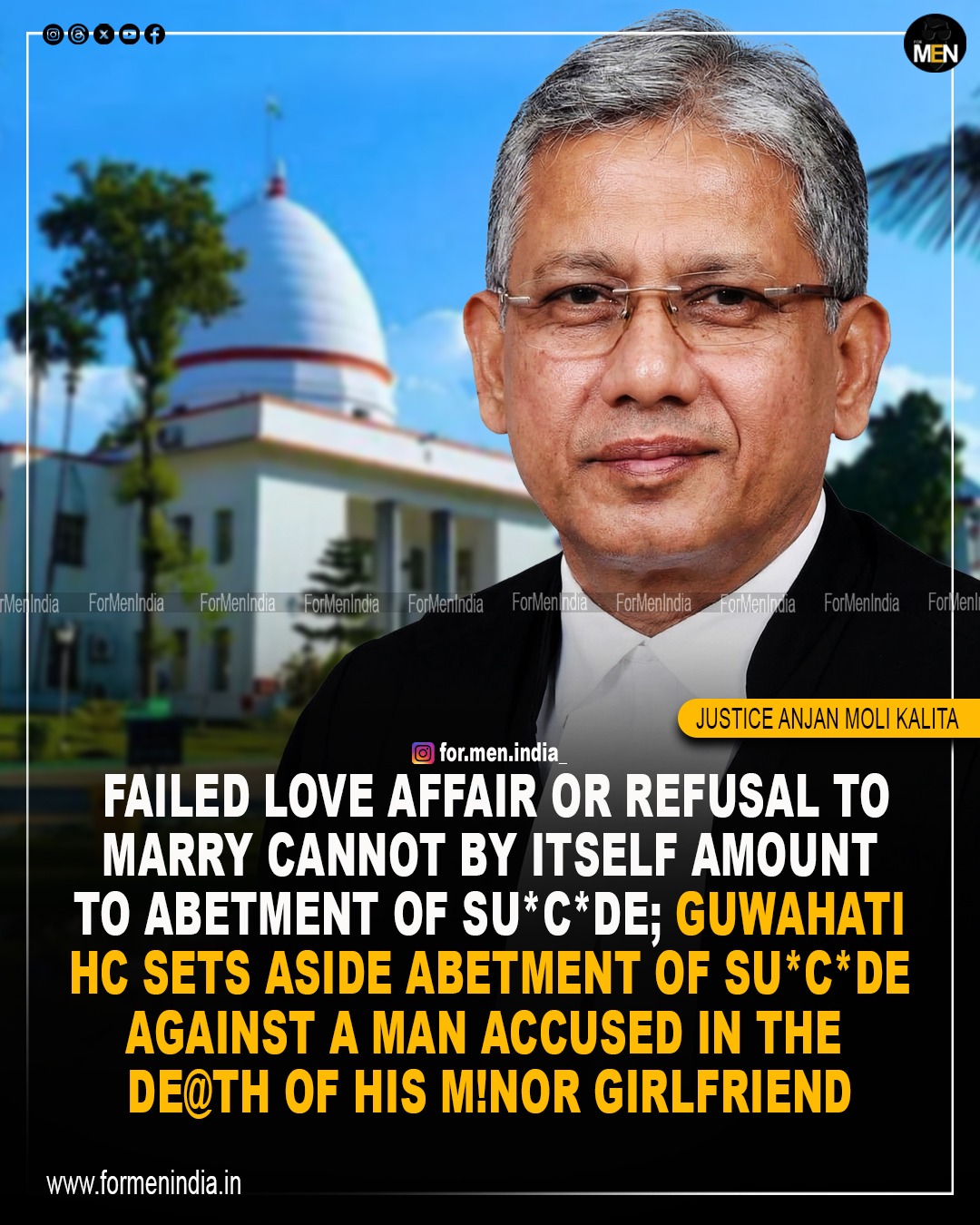
The case originated from an FIR lodged by the father of the deceased, alleging that the petitioner had been in a relationship with the deceased for about two years on the promise of marriage and had established a physical relationship with her. It was alleged that the Petitioner later refused to marry her due to which she suffered mental agony, following which she committed suicide. During the investigation, provisions of Section 376 IPC and Section 6 of the POCSO Act were also added, and cognizance was taken accordingly.
Against this, the Petitioner assailed the order of the Special Judge, Nagaon, arguing that the ingredients required under Section 107 IPC to constitute an offence under Section 306 remain absent. He submitted that the Special Judge, in taking cognizance of the offence under the above sections, has committed a gross error of law and facts, meriting the order to be set aside and quashed.
The court further said that while considering an allegation of abetment of suicide, the Court needs to look into the human behavioural history of the person who has committed suicide. It needs to look into the aspect of mens rea or intentional commission of an act which leads to commission of the suicide with reference to the actual acts and deeds of the accused.
In this background the high court said, “…this Court has analysed the behavioural aspects of both the accused and. the deceased. As far as deceased is concerned, there is no material on record which suggest that the deceased was having any history of being a very sensitive person or a different person who needs to be taken in a different footing. As far as, the accused person is concerned, though it is seen that he was boosting about his sexual triumphs on the deceased, other than that,this Court could not prima facie found any mens rea or intentional act which probably could have forced the deceased person to commit the suicide“.
The Petitioner argued that the establishment of sexual relations with the deceased could not be discerned from the usage of the expression “physical relations” as mentioned in the FIR.
However, satisfied with the presence of foundational ingredients, the Court declined to interfere with the cognizance taken under Section 376 IPC and Section 6 of the POCSO Act. It noted that the allegations and materials collected during the investigation disclosed a sustained sexual relationship between the petitioner and the deceased over a period of time, originating when the deceased was at that time a minor.
“Another factor that has been considered by this Court while coming to the aforesaid prima facie finding is that the Certificate of Date of Birth of the deceased girl clearly establishes at this stage that the deceased girl was of 19 years at the time of commission of suicide by her, which means that while commission of the alleged offence, the deceased girl was a minor because the allegation was that the Petitioner had committed the offences during the last two (2) years since her commission of suicide to attract Section 376 of the Indian Penal Code and Section 6 of the POCSO Act,” the court said dismissing the contention that the deceased was a major.
The Court rejected the contention that the usage of the expression “physical relations” was insufficient to attract POCSO provisions, observing that the vernacular term used in the FIR ordinarily denotes a sexual relationship.
The Court partly allowed the petition, setting aside the cognizance under Section 306 IPC, while permitting the prosecution to proceed under Sections 417 and 376 of the IPC read with Section 6 of the POCSO Act.
Case title: Hussain Md. Rijuan v/s The State of Assam