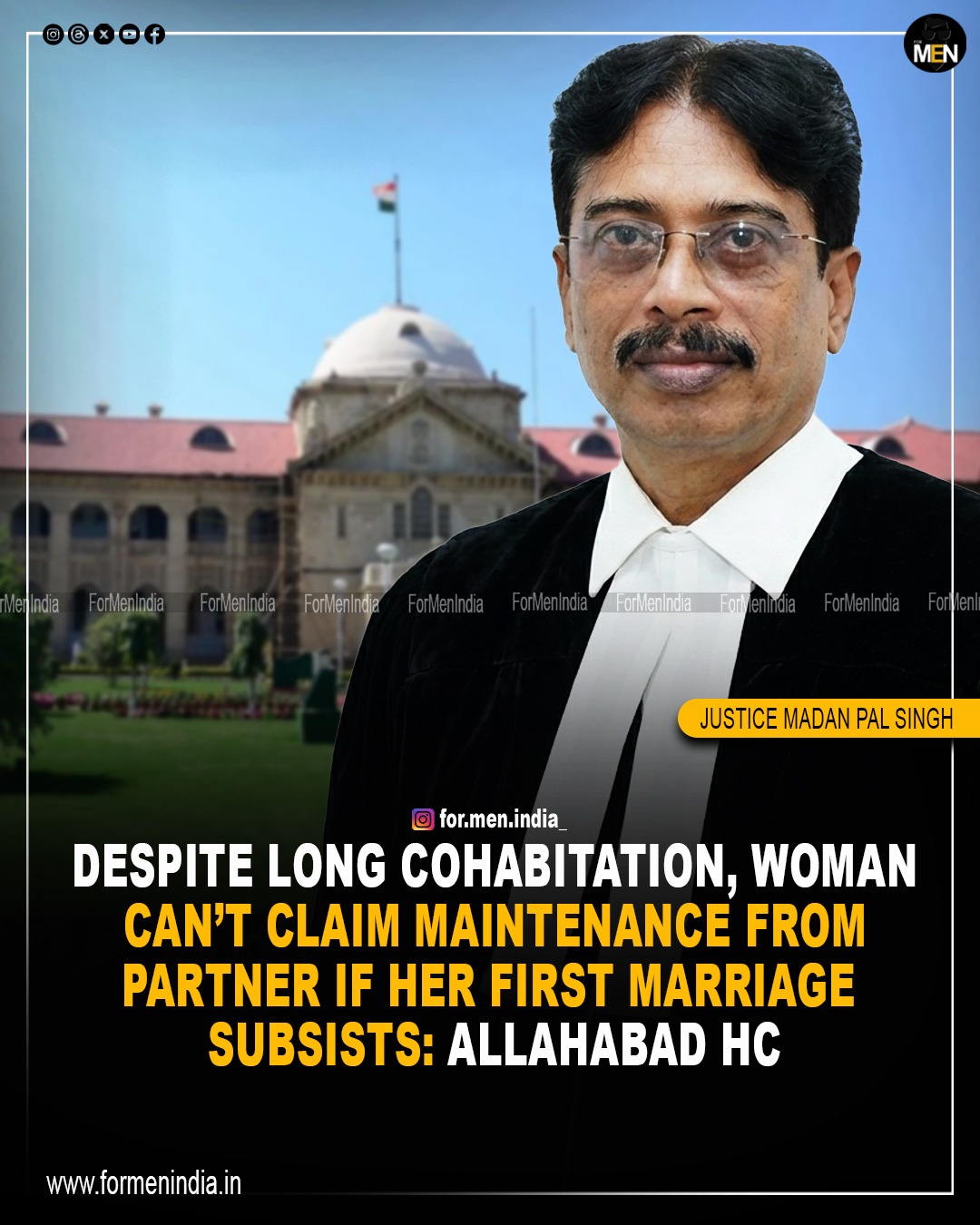
The Court observed thus while dismissing a revision petition filed by a woman challenging an order by the trial court which had rejected her maintenance application.
The Revisionist claimed she had married Opposite Party No. 2 in June 2009, after he represented that he had severed ties with his former wife via a settlement in August 2005.
She submitted that they cohabited as husband and wife for nearly a decade and her status as his wife was recorded in official documents such as her Aadhaar Card and Passport.
She further alleged that after ten years, she was subjected to cruelty and deserted in March 2018 and therefore, she had to move the court to seek maintenance.
On the other hand, the Opposite Party No. 2 contested her claim by arguing that the Revisionist was merely the daughter of his “distant aunt” and that no valid marriage existed between them.
It was also submitted that the Revisionist had never obtained a final decree of divorce from her first husband and thus, she could not seek maintenance from him as she is a legally wedded wife of another man.
Against the backdrop of these arguments, the High Court examined the records of the case and noted that the Revisionist was already married and although she had instituted a divorce petition, the same was dismissed in default.
Consequently, the Court noted that her first marriage was still subsisting in law.
Furthermore, the Court noted that even the Opposite Party No. 2 (Husband) was also already married to a woman and that marriage had also not been dissolved.
Referring to Section 11 of the Hindu Marriage Act, which declares that a marriage contracted during the lifetime of a living spouse is void ab initio, the Court reasoned that since both parties were married to other persons, their relationship could not create the legal status of husband and wife between them.
Importantly, the counsel for the wife-revisionist relied on the Supreme Court judgment in Badshah vs. Urmila Badshah Godse & Anr. (2014), wherein it was held that the wife of a second marriage is entitled to maintenance in case the husband has duped her into getting married.
However, the High Court distinguished the present case from the top court’s Judgment, noting that in the 2014 case, the second wife was unaware of the husband’s first marriage and she herself was eligible to marry.
However, in the present case, the Court noted, the Revisionist herself admitted to a subsisting marriage with no decree of divorce. Therefore, the Court noted:
“Her plea that she acted on the basis of mutual settlement and notarized deed cannot confer her legal status…Therefore, the plea of ignorance regarding the dissolution of first marriage cannot be accepted.”
The HC also relied on the 2005 judgment of the Supreme Court in Savitaben Somabhai Bhatiya vs. State of Gujarat, where it was held that ‘wife’ cannot be expanded to include a woman not legally married.
Thus, the High Court concluded that the Revisionist does not fall within the ambit of a “legally wedded wife” and thus was not eligible to claim compensation from her partner, even if she was in a long-standing relationship with him.